Helen Saulnier
Salman Khan and his relatives have been working spherical the clock to shovel the mud and h2o out of their dwelling in Nowshera, a riverside town struck by devastating floods late final month.
“I swear it’s been 4 or five days since any of us have slept,” he says. “We expend all day and evening making an attempt to clear up the mess.”
Why We Wrote This
Catastrophic flooding throughout Pakistan is demanding more than resilience it’s forcing communities to make difficult selections about what can be saved and where by to immediate help.
In Nowshera and across Pakistan, file flooding has examined the resilience of community family members as nicely as authorities, who are scrambling to comprise a disaster that is left a lot more than 1,200 men and women dead considering that the monsoon commenced at the close of June.
Officials maintain that the destruction could have been far increased experienced the governing administration not figured out from the past round of catastrophic floods in 2010. Nonetheless, coordinating the humanitarian reaction has proved a challenge, not least because Pakistan is in the middle of a price tag-of-living disaster that has left extensive swaths of the inhabitants battling to maintain by themselves. The compounding crises have compelled quite a few on the entrance strains to adopt solitary-minded goals.
“When I assembled my group on the working day of the flood, I advised them that we just can’t handle the damages that will acquire position, but what we can do is guarantee that no life is dropped,” claims Deputy Commissioner Reza Ozgen.
Nowshera, Pakistan
Exterior the entrance to his flood-weakened house, 18-12 months-outdated engineering student Rehanullah Khan rests in opposition to the trunk of a winding tree. He is dressed in a regular cotton kurta shalwar, tunic and trousers, which could at the time have been grey or blue but are now entirely brown, caked with levels of mud.
For the earlier two days, he and his relatives have been operating round the clock to shovel all the mud and water out of their home, struck by the recent floods. Following taking a second to capture his breath, he picks up his shovel and gets again to do the job, clearing a route from the highway to his doorway.
“No 1 has appear to assist us, not from the government or anyplace else,” he says. “Officials from the administration say that if they arrive down here, they may well slip in the mud and split their bones.”
Why We Wrote This
Catastrophic flooding through Pakistan is demanding a lot more than resilience it is forcing communities to make complicated selections about what can be saved and where to direct support.
In some of the places that Mr. Khan has not nonetheless cleared, the mud lies 3 ft deep. His cousin, Salman, who life in the very same home, says that the family has lost most of their belongings in the flood. “We had to get out of below in a hurry and we were only in a position to acquire a pair of points,” he says. “Everything else obtained taken by the water. I swear it is been 4 or five days given that any of us have slept. We invest all working day and evening trying to clear up the mess.”
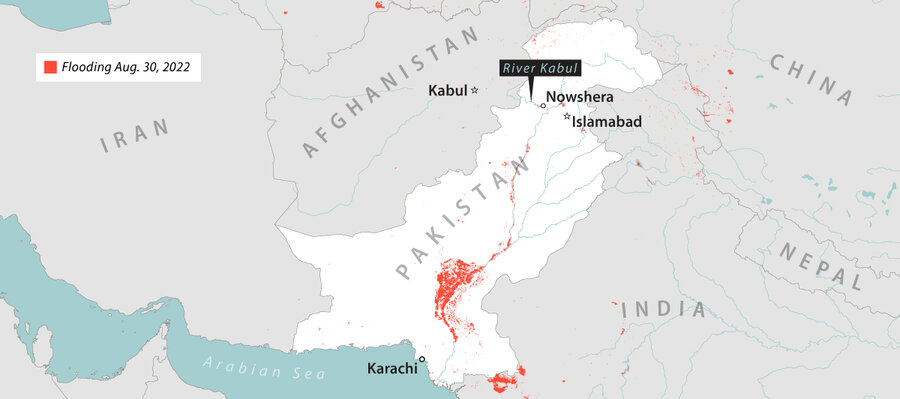
The cousins dwell in a poverty-stricken neighborhood known as Sultanabad in the city of Nowshera on the banks of the River Kabul, which surged in the early hours of Aug. 27. As in other sections of the nation, the document flooding has tested the resilience of area families as effectively as the district administration, which has been scrambling to incorporate the crisis and evacuate victims to increased ground.

“We experienced a single goal in our minds,” claims Deputy Commissioner Reza Ozgen, the leading civil servant in the district. “When I assembled my group on the day of the flood, I explained to them that we cannot command the damages that will acquire position, but what we can do is make sure that no life is shed and which is what we had been thriving in.”
That is a important accomplishment extra than 1,200 people – practically a person-third of them young children – have died since the monsoon started at the conclude of June. Sherry Rehman, the government’s weather change minister, calls the flooding a disaster of “unimaginable” proportions imposed by “other nations around the world that have gotten rich on the back of unchecked fossil gasoline intake.”
Pakistan is especially susceptible, she says, “because we are on the front traces … [with] the major number of glaciers in the world, as very well as the hottest towns on the earth.”
Lessons from 2010
The final catastrophic floods in Pakistan occurred in 2010, when more than 20 million folks missing livestock, farmland, or homes. Early indications suggest that this monsoon is most likely to be even more devastating: The Countrywide Disaster Administration Authority calculates that more than 33 million people today are most likely to be impacted.
In Nowshera, officers estimate that more than 8,000 residences have been partly or entirely broken – a quantity that is expected to rise substantially as much more stories occur in from the area. Gul Mohammad, who utilised to make a living pushing an ice-product cart, is a single of several whose households have been left uninhabitable. He is now sleeping tough on a straw bed in the highway. “Everything is finished. I’ve misplaced almost everything,” he suggests. “Praise be to Allah I’m continue to alive – but that is it.”
LANCE Around Actual Time (NTR)
|
Karen Norris/Workers
Regional officers sustain, having said that, that the hurt could have been far increased experienced successive governments not acquired classes from the floods of 2010. Assistant Commissioner Ummar Awais Kiani factors to the flood defense wall designed by the federal government alongside the River Kabul as proof that progress had been manufactured in disaster preparedness.
“If this protection wall hadn’t been built, we would have had complete devastation. The complete district would have been flooded,” he states.
At the same time, the regional government has also come under criticism. Senior civil servant Mr. Ozgen argues that riverbed encroachment, by illegally produced properties, has narrowed the stream of h2o in areas like Nowshera and enhanced the chance of flooding.
“Over time our establishments have come to be weak,” he states. “There are a lot of loopholes the place creating designs are accredited, and we know why they’re authorised – by means of somebody’s influence or below the table … you know … and finally the state has to pay out the selling price for that.”

Humanitarian reaction
It has also been a challenge to coordinate the humanitarian response, not the very least mainly because Pakistan is in the middle of a price-of-dwelling disaster that has still left broad swaths of the populace having difficulties to maintain themselves. “It’s not that the help hasn’t come,” suggests Mr. Mohammad. “It’s just that there are so several folks who have turned up from much and broad, environment up tents and pretending to be flood victims. They’ve stolen the morsels out of our mouths.”
This has obliged the district administration to change its tactic towards distributing help. “Initially we experienced 71 relief camps,” says Mr. Ozgen. But “slowly we started off acquiring out that men and women who were not influenced have been coming to people camps and using all the goods,” he points out. “Now we’re operating only four [camps] and these are the types exactly where the true affectees are staying.”
The transform of technique has included encouraging as lots of of the flood victims as achievable to return to their own properties, whose sorry affliction is proof of their inhabitants’ want. “As prolonged as they go again, we will be in a position to present rations to their residences,” says Mr. Ozgen. “Secondly, they will enable our administration and the municipal providers to distinct the streets and cleanse the properties.”
But some reduction workers obstacle this solution. “The area formal has explained to me to change persons back again home, but I really don’t know how I’m meant to do that,” complains Muhammad Ismail, who operates a reduction camp in a Nowshera faculty. The camp’s people are refusing to leave, he suggests, “and even if I was equipped to evict them by drive, the place will these men and women go? Their residences are knee deep in h2o and mud.”
But the authorities have suspended aid aid to Mr. Ismail’s camp, and he says he can not continue to feed the 50 little ones under his care from his possess funds. “Adults can go hungry but what are we to do about these kids?” he asks. “How are they intended to get by without any guidance?”
Qurut-ul-ain Wazir, the official tasked with coordinating the government’s reduction efforts, argues that presented the scale of the catastrophe her group will never ever be ready to satisfy all the needs she is appealing for support from non-public teams.
“Because this is an emergency, we simply cannot reach 100% results,” she claims. “We might be ready to clear up 60 or 70% of the problems, but the remaining 30% has to occur from the nongovernmental sector.”